From Code to Cloud: The DevOps Journey
In today's fast-paced digital world, people expect apps to be reliable, quick, and always up to date. When development and operations worked separately, as they did in the past, they often caused delays and problems with deployment.
DevOps fixes this by combining development and operations into one process. It lets teams automate tasks, work together better, and deliver software quickly.
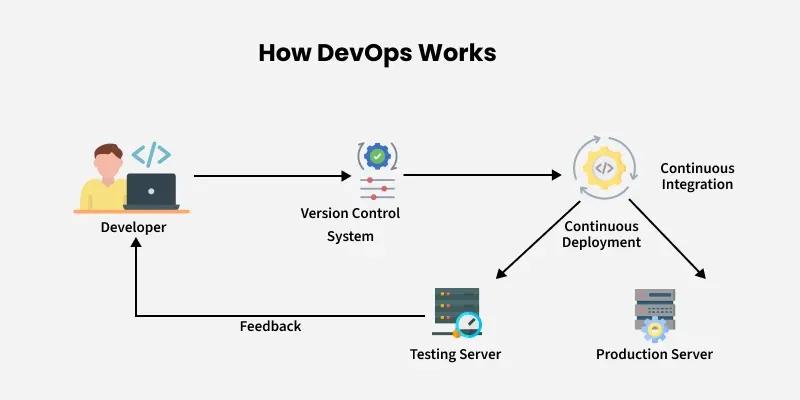
What does DevOps mean?
DevOps is not only about set of tools or a way of how things are done; it's a way of thinking.
It integrates:
Development and operations for developing, testing, and releasing software products in a fast and efficient manner.
DevOps concepts comprise of:
1. Automation: Execution of pipelines to reduce manual effort.
2. Cooperation: Working together to solve problems faced by various teams.
3. Continuous Improvement: Feedback and iteration.
4. Reliability: Making systems robust and scalable.
Therefore, DevOps is all about releasing applications in a fast and efficient manner.
The DevOps Lifecycle (A Loop That Never Ends)
The DevOps lifecycle is a never-ending cycle that makes sure things keep getting better.
Make a plan:
Teams use tools like Jira or Trello to set requirements, features, and deadlines.
Code:
developers uses Git to write code and keep the track of different versions.
Build:
Code is put together and packaged into containers or executable formats.
Testing:
Automation tests (unit, integration, and UI) make sure that the code is good.
Release:
The app is ready to be used.
Deployment:
The app is sent to servers or the cloud.
Keep an eye on:
We keep an eye on performance, logs, and errors all the time.
This loop repeats itself enabling fast innovation and improvement.
CI/CD Pipeline: The Heart of DevOps
The CI/CD pipeline is at the heart of DevOps.
Continuous Integration (CI)
Developers often send code to a shared repository.
Automated builds and tests start right away.
Early detection of errors
Continuous Deployment (CD)
Code is automatically deployed after it passes tests.
No need for manual intervention
Allows for faster delivery
Sample Workflow:
Developer sends code to GitHub
GitHub Actions starts the pipeline
The code is made and tested.
A Docker image is made.
Put in the cloud
Result: Faster releases with few bugs.
Actual Flow: From Coding to Implementation in the Cloud.
Following are the steps from coding until the implementation in the cloud:
Step 1: Coding
Frameworks like React, Node.js, Flask are some frameworks for developing software code.
Step 2: Version Control
Codes are pushed in version control systems like GitHub.
Step 3: Initiate the CI/CD Pipeline
These tools are used for the automation of the process.
Step 4: Testing
Automation testing helps in validating whether software codes are working correctly.
Step 5: Containerization
Applications are deployed in Docker containers.
Step 6: Orchestration
Kubernetes helps in managing the scaling and load balancing and the deployment of applications.
Step 7: Deployment of Application in the Cloud
The deployment of applications can be made possible using the cloud platform such as AWS, Azure, and Google Cloud Platform.
Step 8: Monitoring & Feedback.
Essential Stack for DevOps Tools:
Version Control Tools: Git and GitHub CI/CD Tools: Jenkins and GitHub Actions.
Putting things in containers.
Tools: Docker
Kubernetes is an orchestration tool.
Cloud Platforms
AWS, Azure, and GCP are tools.
Monitoring tools: Prometheus and Grafana
Every tool is important for automating and scaling workflows.
DevOps Benefits:
Faster Delivery
Releases happen often, and the development cycles are shorter.
Updates All the Time
Instead of waiting for updates, apps change all the time.
Fewer Mistakes
Automated testing finds bugs early.
Better working together
The people who write code and run the business work together.
Better Monitoring
Get real-time information about how well the system is working.
DevSecOps:
It is the combination of DevOps and Security.
DevSecOps makes sure that security is a part of every step:
Safe ways to write code.
Scanning for vulnerabilities automatically.
Always watching for security issues.
Result: Applications that are safe and dependable.
Future of DevOps:
The future is even greater:
AIOps (Artificial Intelligence Operations)
AI automates monitoring, debugging, and optimization.
Serverless Computing
No servers required; just function deployment.
DevSecOps Expansion
Security is entirely automated.
Hyper Automation
Everything is automated—from development to delivery.
Conclusion:
DevOps has revolutionized software development and deployment by removing any limitations and enabling organizations to operate efficiently and at a faster pace.
DevOps makes sure that everything is automated—from coding to deploying applications in the cloud environment.
In today’s technological world, DevOps is a must-have skill for any developer.